
At airports, clear guidance is essential for safe and efficient flow. It’s not just about planes reaching the runway—it also involves staff, service vehicles, passengers, and cargo moving through areas where misdirection can create hazards. That’s why airport signage plays a vital role: more than simple markers, it acts as a visual language that directs movement, identifies spaces, and helps everyone understand their surroundings with confidence.
Traffic cones, traffic barriers, traffic barrels, LED traffic batons, LED strobe beacon lights, LED warning lights, LED arrow boards, as well as perimeter fencing and mesh systems are standard tools in roadways, construction sites, and parking facilities. Their functional design, however, makes them equally effective in airport environments, where they can be strategically deployed to reinforce both airside and landside safety.
Why Airport Signage Matters
Clear signage at airports helps everyone navigate safely, indicating where to walk, where to stop, which places to avoid, and which areas need extra caution. Airports include a variety of spaces—pedestrian walkways, internal traffic lanes, aprons, service areas, restricted areas, and locations near runways—where signage plays a vital role in keeping operations smooth and secure.
Clear visual information enables staff to make faster and more effective decisions. Airport signage delivers guidance and minimizes confusion for maintenance vehicles, operators, suppliers, and emergency teams.
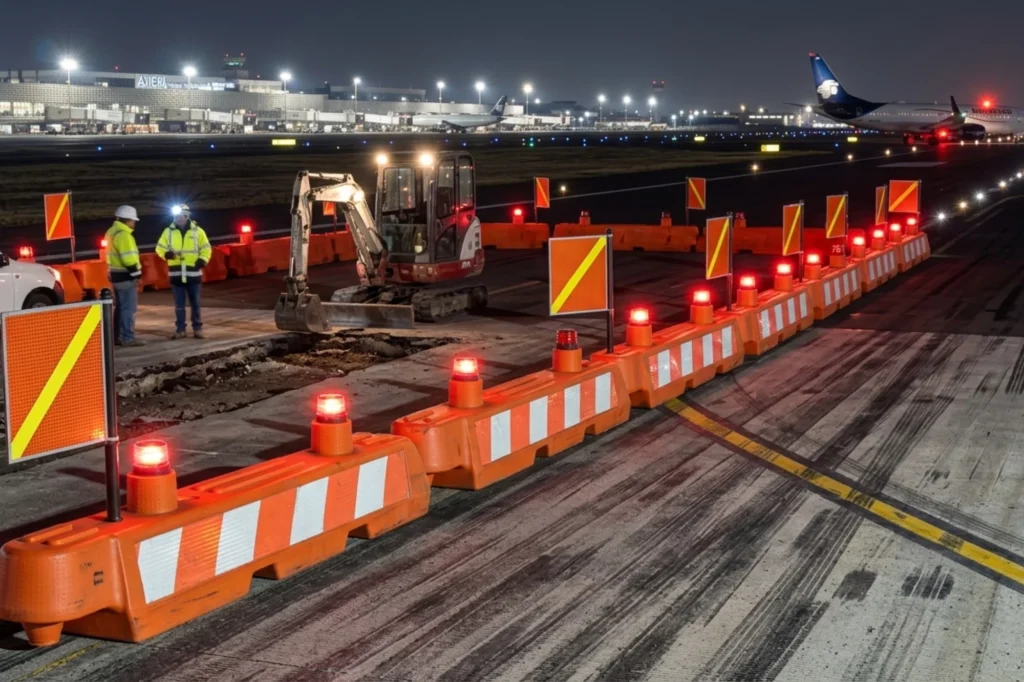
Off-Road Traffic Elements
Traffic control devices serve more than roads. Practical design, striking colors, and easy installation make them highly effective in airports, logistics centers, cargo areas, and restricted access zones.
For this reason, airport signage is adapted using mobile or fixed elements, depending on operational requirements. Some elements support maintenance activities, others permanently define specific zones, and others provide guidance at night or in low-visibility conditions.
Traffic Cones and LED Traffic Batons for Airport Signage
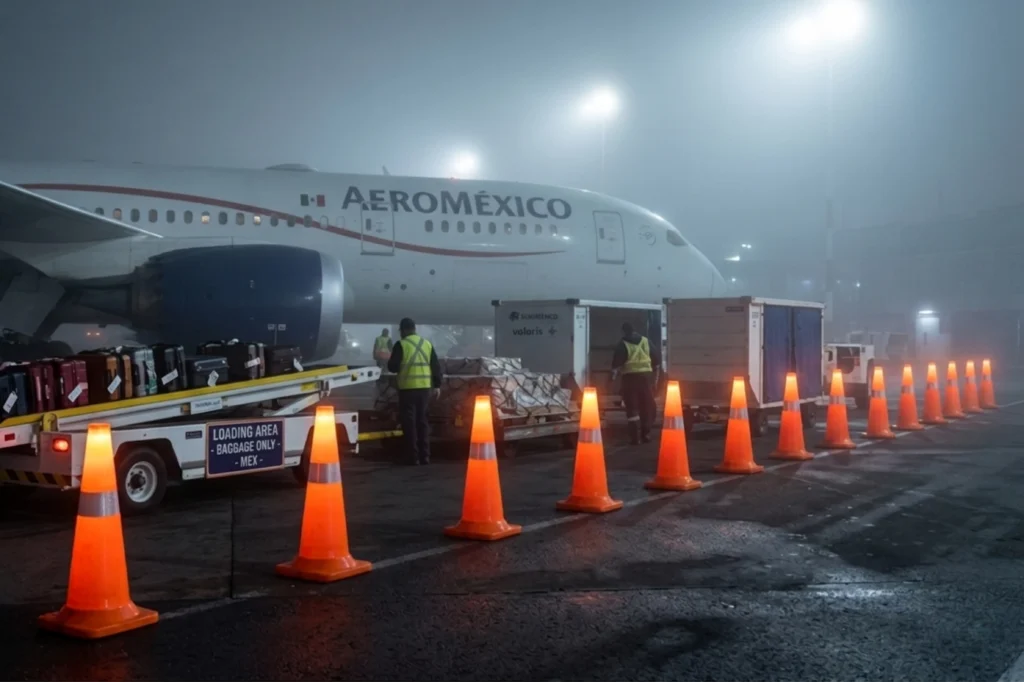
Traffic cones and LED traffic batons for airports serve as practical solutions for marking areas without blocking operations. In particular, they can be deployed in waiting zones, internal routes, maintenance areas, service entrances, or any point where an immediate access restriction must be signaled.
These traffic control devices are easy to move, organize, and adapt. Additionally, their height, color, and visual presence help operators and drivers become aware of route changes. Within airport signage systems, they serve as clear reference points for controlling traffic flow without the need for permanent structures.
Clearly Visible Traffic Barriers And Traffic Barrels
High-visibility traffic barriers and traffic barrels are used to establish firm boundaries. In these cases, it’s not enough to warn—there is also a need to protect, separate, or restrict access. Accordingly, they may be placed on internal roads, controlled access points, worksite boundaries, loading areas, and spaces adjacent to specialized activities.
In airports, these elements create clear separations between vehicle routes, pedestrian zones, and restricted areas. Therefore, airport signage should include solutions that are durable, highly visible, and easy to interpret.
Handheld LED Safety Lights for Roadway Control
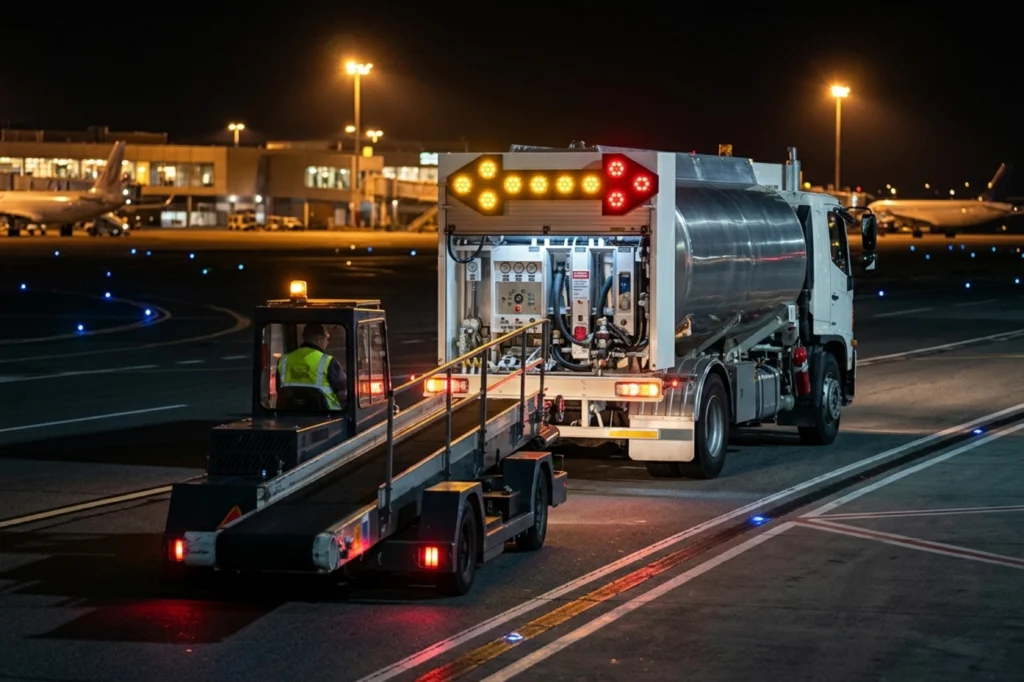
Handheld warning lights, LED strobe beacon lights, and LED arrow boards enhance direction if natural or ambient lighting is poor. In particular, at night, in rainy or foggy conditions, or in busy zones, light-based signals quickly draw attention and help minimize confusion.
Moreover, these traffic control devices work as a supplement to runway signage, helping deliver warnings, define boundaries, and assist with specialized operations outside standard markings.

Airport Signage For Area Delimitation
Delimiting areas does not imply complete closure. The process involves identifying which spaces remain active, which demand caution, and which must remain inaccessible. In this context, perimeter fences and mesh systems become essential, particularly in work zones, service access areas, security boundaries, and controlled spaces.
Fences organize movement, while mesh systems create visible separations without blocking the view of the surroundings. Together with other airport signage elements, these solutions help ensure that each space has a clearly defined function and that personnel can recognize boundaries without the need for improvised instructions.
Visual Understanding In Critical Areas
An airport should remain easy to understand, even for users who don’t know every route. For this reason, visual comprehension becomes critical. Accordingly, airport signage and support traffic control devices must be placed with each user in mind—apron staff, maintenance teams, security, suppliers, passengers, and internal vehicle operators.
Logical distribution of elements makes the environment easy to understand. Traffic cones indicate temporary changes, traffic barriers establish separation, LED warning strobe beacon lights deliver warnings, arrow boards guide circulation, and mesh systems secure perimeters. Together, these resources create a coherent visual language that supports safety and order.
Airport Security Supported By Traffic Control Elements
Airport security cannot depend on just one type of signal. Rather, it involves combining markings, signage, lighting, and physical traffic control devices according to each specific area of use. Across runways, aprons, internal roads, and service zones, every element must help enable fast decisions such as moving forward, stopping, rerouting, waiting, or restricting access.
Therefore, discussing airport signage also involves recognizing the value of carefully selected traffic solutions. It is not about simply transferring traffic control devices to another setting, but about leveraging their visibility, durability, and ease of installation to strengthen areas where operational order is essential.
A Guiding System That Protects Every Zone
Airport signage must improve the understanding of every area. Whether on a runway or at a service entrance, properly positioned visual elements help minimize confusion, protect designated spaces, and keep operations flowing safely and efficiently.
Traffic cones, LED traffic batons, traffic barriers, traffic barrels, LED warning lights, fencing, and perimeter mesh can form part of a comprehensive visual strategy. In fact, their use demonstrates that traffic elements play an essential role in the airport environment, providing that they are selected according to the area, function, and required operational control. When properly implemented, these solutions help improve spatial organization, guide vehicle and pedestrian movement, and reinforce safety protocols across different operational zones. Their effectiveness depends on correct placement, clear visibility, and adaptation to the specific conditions of each area within the airport infrastructure.